Searching for evidence of Extraterrestrial Intelligence in the Solar System might sound ambitious, but it is a plausible, potential scenario. Some have argued that the recent interstellar visitor Oumuamua presented enigmatic characteristics suggestive of a now inert Extraterrestrial Artefact.
There have already been a number of searches for evidence Extraterrestrial Artefacts at the Lagrange points in the Earth-Moon system i.e. the locations in space where the Earth and the Moon’s gravitation pull is equally matched; effectively creating gravity wells where an object could be parked and remain undisturbed for millennia. And whilst these largely optical searches have yet to detect anything, an object would have to be of appreciable size to be found by such methods (certainly in the tens of metres). Whereas, an ETI nano-probe might be no larger than a melon.
EAAROCIBO
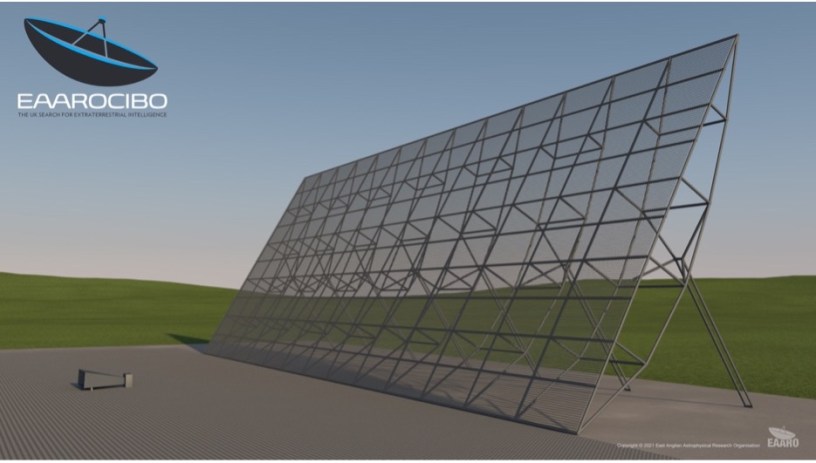
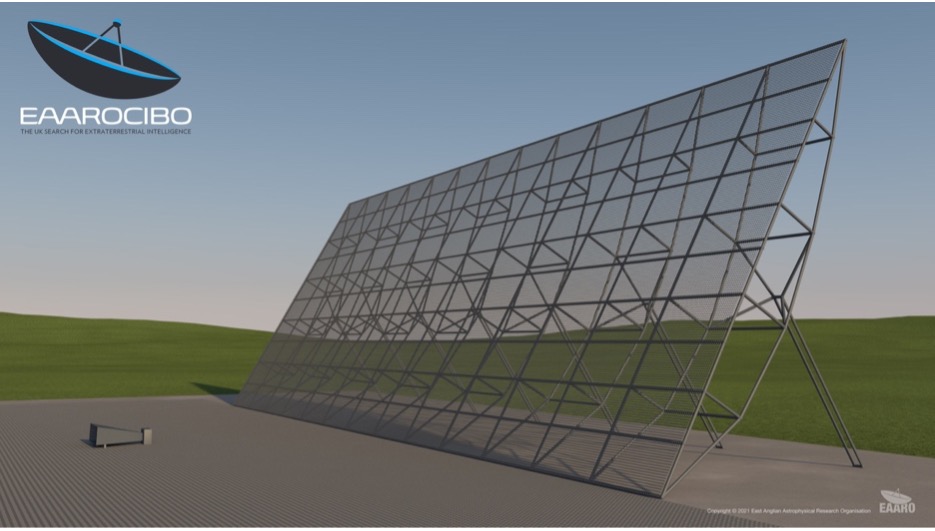
In late 2020, the charitable research group East Anglia Astrophysical Research Organisation EAARO (its stated mission: ‘To Inspire And Educate Through Meaningful Space Research’) announced plans for a UK SETI project named EAAROCIBO, in honour of the now defunct Arecibo telescope made famous in the movie Contact. In order that this project complements other SETI efforts, rather than competes with them, founder Jason Williams and his colleagues have consulted with the SETI Institute in California to gauge their views on the proposal.
EAAROCIBO is envisaged as similar in construction to the ‘Big Ear’ telescope designed by John Kraus, once used at Ohio State University Radio Observatory (It was on this very telescope that the now famous “Wow!” signal was detected, arguably the best candidate for an actual detection of ETI).
But, whereas most SETI searches are conducted in the microwave region of frequencies (a thousand million cycles per second measured in Gigahertz) EAAROCIBO will conduct its searches in low frequency wavelengths (30 Mhz to 2 Ghz). And it will not be searching for the same kind of high-powered beacons from ET that traditional SETI does, but rather listen for radio interference (RFI) caused by potential Extraterrestrial machinery – perhaps AI-controlled bots mining the mineral wealth in the asteroid belt of our own solar system!
Open Reach Science

EAAROCIBO will have other exciting scientific uses such as monitoring terrestrial spacecraft engaged in various activities throughout the solar system and beyond, such as asteroid mining surveys expected to commence in 2030.
Plans for EAAROCIBO originate from an educational organisation that could potentially provide free access to real-time data from its Cambridgeshire mission control, for schools, colleges and universities throughout the UK, and also public library free-to-use PC’s.
Funding Opportunities
Ideal sponsors for such a culturally enriching Open Reach project might be from the burgeoning AI-development sector in the UK, and similar hi-tech industries. In the afore-mentioned Contact, Jodie Foster’s character makes this impassioned plea for SETI funding to Executives of a major tech corporation:
“All I’m asking is for you to just have the tiniest bit of vision, to step back for one minute and look at the big picture. To take a chance on something that just might end up being the most profoundly impactful moment for humanity – for the history…of history!”
It works just as well here.
John Keeling is a Content Provider & Curator for the EAAROCIBO Facebook page, though his opinions are his own.
 JOHN KEELING MEDIA